
Discover how to calm your nervous system, overcome chronic stress, and reclaim your wellbeing with proven techniques tailored for LGBTQI+ individuals in the UK.
Burnout has become an epidemic in modern life, but for LGBTQI+ adults, the experience often runs deeper. The combination of everyday workplace pressures, societal expectations, and the unique burden of minority stress can leave your nervous system trapped in a perpetual state of high alert. If you’ve been feeling exhausted, emotionally drained, and unable to switch off, you’re not alone—and more importantly, there is a clear pathway to recovery.
This comprehensive guide explores the science of nervous system regulation and provides practical, evidence-based techniques specifically designed to help LGBTQI+ adults beat burnout. Whether you’re seeking immediate relief or long-term transformation, these strategies—including the powerful combination of HypnoCBT—can help you restore balance and rebuild your resilience.
What Is Nervous System Regulation and Why Does It Matter?
Nervous system regulation refers to your body’s ability to move smoothly between states of alertness and relaxation. When functioning optimally, your nervous system responds appropriately to stressors and then returns to a calm baseline. However, chronic stress disrupts this natural rhythm, leaving many people stuck in a constant state of hypervigilance.
For LGBTQI+ individuals, this dysregulation often becomes more pronounced due to the cumulative effects of minority stress—the ongoing psychological burden of navigating a world that doesn’t always feel safe or accepting. Understanding how your nervous system works is the first step towards reclaiming control over your stress response.
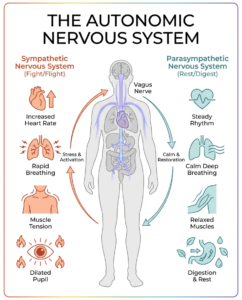
The Autonomic Nervous System Explained
Your autonomic nervous system operates largely outside your conscious awareness, controlling essential functions like heart rate, digestion, and breathing. It comprises two main branches:
The Sympathetic Nervous System (Fight-or-Flight)
This branch activates when you perceive danger, flooding your body with stress hormones like cortisol and adrenaline. Your heart rate increases, muscles tense, and non-essential functions like digestion slow down. Whilst this response is vital for genuine emergencies, chronic activation leads to exhaustion and burnout.
The Parasympathetic Nervous System (Rest-and-Digest)
Often called the “brake pedal” of your nervous system, this branch promotes relaxation, recovery, and healing. When activated, your heart rate slows, muscles relax, and your body can focus on restoration. Learning to engage this system deliberately is central to burnout recovery.
How Chronic Stress Affects Your Body
When stress becomes chronic, your nervous system loses its flexibility. You may find yourself:
- Struggling to fall asleep or stay asleep
- Feeling constantly on edge or irritable
- Experiencing physical symptoms like headaches, muscle tension, or digestive issues
- Finding it difficult to concentrate or make decisions
- Feeling emotionally numb or disconnected
These symptoms indicate that your nervous system has become dysregulated—stuck in survival mode even when there’s no immediate threat. The good news is that with the right techniques, you can retrain your body’s stress response.
Understanding Minority Stress and Its Impact on LGBTQI+ Mental Health
Minority stress is a well-documented phenomenon that significantly affects LGBTQI+ mental health. First conceptualised by researcher Ilan Meyer, this framework explains how the chronic stress of belonging to a marginalised group creates additional psychological burden beyond everyday life stressors.
Sources of Minority Stress
LGBTQI+ individuals often experience stress from multiple sources:
External Stressors
- Discrimination in the workplace, healthcare settings, or public spaces
- Microaggressions—subtle but harmful comments or behaviours
- Fear of rejection from family, friends, or colleagues
- Navigating legal and institutional barriers
- Exposure to anti-LGBTQI+ rhetoric in media and politics
Internal Stressors
- Internalised homophobia, biphobia, or transphobia
- Concealment stress—the exhausting effort of hiding aspects of your identity
- Anticipation of rejection or discrimination
- Hypervigilance in social situations
The Cumulative Effect on Your Nervous System
Each of these stressors, whilst perhaps manageable in isolation, creates a cumulative burden that keeps your nervous system on high alert. Over time, this constant vigilance depletes your energy reserves and makes you more vulnerable to burnout.
Research published in the Journal of Counseling Psychology demonstrates that LGBTQI+ individuals experience higher rates of anxiety, depression, and stress-related conditions compared to their heterosexual and cisgender counterparts. However, this isn’t an inherent characteristic of being LGBTQI+—it’s a direct result of navigating minority stress.
Understanding this context is crucial because it validates your experience and points towards targeted solutions. You’re not “too sensitive” or “unable to cope”—you’re dealing with genuine, measurable stressors that require specific strategies to address.
Evidence-Based Techniques for Nervous System Regulation
Now that we understand the science behind stress and burnout, let’s explore practical techniques you can implement today. These evidence-based strategies are designed to activate your parasympathetic nervous system and restore balance.
Grounding Techniques for Immediate Relief
Grounding techniques anchor you in the present moment, interrupting the cycle of anxious thoughts and bringing your attention back to safety. These methods are particularly effective during moments of acute stress or when you feel overwhelmed.
The 5-4-3-2-1 Technique
This sensory-based exercise engages all five senses to ground you in the present:
- Identify 5 things you can see around you
- Notice 4 things you can physically feel (the texture of your clothing, the chair beneath you)
- Listen for 3 sounds in your environment
- Identify 2 things you can smell
- Notice 1 thing you can taste
This technique works by redirecting your brain’s attention away from perceived threats and towards neutral sensory information, signalling to your nervous system that you are safe.
Physical Grounding
When anxiety feels overwhelming, physical grounding can provide rapid relief:
- Press your feet firmly into the floor, noticing the sensation of solid ground beneath you
- Hold a cold object (ice cube, cold drink) and focus on the temperature
- Splash cold water on your face or wrists
- Engage in brief, vigorous movement like jumping jacks or shaking your hands
Paced Breathing for Parasympathetic Activation
Breathing is unique among bodily functions because it operates both automatically and under conscious control. This makes it a powerful tool for influencing your nervous system state.
Extended Exhale Breathing
The key to activating your parasympathetic nervous system lies in extending your exhale. When you exhale longer than you inhale, you stimulate the vagus nerve and trigger a relaxation response.
Try this pattern:
- Inhale through your nose for 4 counts
- Exhale slowly through your mouth for 6-8 counts
- Repeat for 5-10 cycles
Box Breathing
Used by military personnel and first responders, box breathing is excellent for high-stress situations:
- Inhale for 4 counts
- Hold for 4 counts
- Exhale for 4 counts
- Hold for 4 counts
- Repeat for 4-6 cycles
Physiological Sigh
Research from Stanford University has identified the “physiological sigh” as one of the fastest ways to calm your nervous system:
- Take a deep breath in through your nose
- At the top of the breath, take a second, smaller inhale to fully expand your lungs
- Exhale slowly and completely through your mouth
Even a single physiological sigh can produce measurable reductions in stress markers.
Progressive Muscle Relaxation (PMR)
Progressive muscle relaxation is a systematic technique that involves tensing and then releasing different muscle groups throughout your body. Developed by physician Edmund Jacobson in the 1930s, PMR remains one of the most effective methods for reducing physical tension and promoting relaxation.
How to Practice PMR:
- Find a comfortable position, either sitting or lying down
- Starting with your feet, tense the muscles as tightly as you can for 5-7 seconds
- Release the tension suddenly and notice the sensation of relaxation for 15-20 seconds
- Move progressively through each muscle group: calves, thighs, buttocks, abdomen, chest, hands, arms, shoulders, neck, and face
- Complete the sequence by taking several deep breaths
Regular practice of PMR can reduce baseline muscle tension, improve sleep quality, and decrease overall anxiety levels. Many people find it particularly helpful as part of a bedtime routine.
Improving Vagal Tone for Long-Term Resilience
The vagus nerve is the longest cranial nerve in your body, connecting your brain to your heart, lungs, and digestive system. “Vagal tone” refers to the activity of this nerve—higher vagal tone is associated with better stress resilience, emotional regulation, and overall health.
Techniques to Strengthen Vagal Tone:
- Cold exposure: Brief cold showers or splashing cold water on your face stimulates the vagus nerve
- Humming, singing, or chanting: The vibrations activate vagal pathways in your throat
- Gargling: Vigorous gargling with water stimulates the muscles at the back of your throat
- Social connection: Positive social interactions naturally enhance vagal tone
- Laughter: Genuine laughter activates the parasympathetic nervous system
- Meditation and mindfulness: Regular practice has been shown to improve vagal tone over time
HypnoCBT: A Powerful Approach to Burnout Recovery
Whilst self-help techniques are valuable, sometimes deeper intervention is needed—particularly when stress patterns have become deeply ingrained. HypnoCBT offers a uniquely effective approach by combining two evidence-based therapies: Cognitive Behavioural Therapy (CBT) and clinical hypnotherapy.
What Is HypnoCBT?
HypnoCBT integrates the structured, thought-focused approach of CBT with the deeper, subconscious work of clinical hypnotherapy. This combination addresses stress and anxiety at multiple levels:
Cognitive Behavioural Therapy (CBT)
CBT helps you identify and challenge unhelpful thought patterns that contribute to stress and anxiety. By examining the relationship between your thoughts, feelings, and behaviours, you can develop healthier ways of responding to challenges.
Clinical Hypnotherapy
Hypnotherapy accesses the subconscious mind, where many of our automatic responses and deeply held beliefs reside. Through guided relaxation and focused attention, hypnotherapy can help rewire these automatic patterns, creating lasting change at a fundamental level.
Why HypnoCBT Is Particularly Effective for Burnout
Traditional talk therapy can be valuable, but it often requires many sessions to produce meaningful change. HypnoCBT accelerates this process by working simultaneously on conscious thought patterns and subconscious programming.
For LGBTQI+ individuals dealing with minority stress, HypnoCBT can be particularly powerful because it addresses:
- Internalised negative beliefs about your identity that may have developed over years
- Hypervigilance patterns that keep your nervous system on high alert
- Automatic stress responses that feel impossible to control consciously
- Self-protective behaviours that once served you but now limit your life
Many clients notice significant improvements within just a few sessions, making HypnoCBT an efficient and effective option for busy professionals who can’t commit to years of weekly therapy.
What to Expect from HypnoCBT Sessions
A typical HypnoCBT session combines several elements:
- Discussion and assessment: Understanding your specific challenges and goals
- Cognitive work: Identifying and reframing unhelpful thought patterns
- Hypnotherapy: Guided relaxation followed by therapeutic suggestions tailored to your needs
- Skills training: Learning techniques you can use independently between sessions
Sessions are collaborative and empowering—the goal is always to equip you with tools and insights you can use long after therapy ends.
LGBTQI+ Affirming Therapy: Why It Matters
When seeking support for burnout and stress, finding a therapist who truly understands LGBTQI+ experiences is essential. Affirming therapy goes beyond mere tolerance—it actively validates and supports your identity as an integral part of who you are.
The Importance of Affirming Therapeutic Spaces
Research consistently shows that LGBTQI+ individuals achieve better outcomes when working with affirming practitioners. In an affirming therapeutic relationship:
- You don’t need to educate your therapist about LGBTQI+ issues
- Your identity is understood as a source of strength, not pathology
- Minority stress is recognised and addressed directly
- You can focus on healing rather than defending your existence
At The Holistic Clinic, we provide affirming therapy that centres your experience. Whether you’re dealing with burnout, anxiety, relationship challenges, or identity exploration, our approach ensures you feel understood and supported from the first session.
Accessing Support: London and Online Therapy UK
We understand that accessing affirming therapy can be challenging, particularly outside major cities. That’s why we offer flexible options:
In-Person Sessions in London
Our London clinic provides a welcoming, confidential space for face-to-face therapy. Many clients find the dedicated time and physical separation from their daily environment helpful for deep therapeutic work.
Online Therapy Across the UK
Our secure online therapy platform allows you to access affirming support from anywhere in the UK. Online sessions are just as effective as in-person therapy and offer additional benefits:
- No travel time or costs
- Greater flexibility in scheduling
- Ability to attend from a comfortable, private space
- Continuity of care even when travelling or relocating
Creating Your Burnout Recovery Plan
Recovering from burnout isn’t about implementing every technique at once—it’s about building sustainable practices that support your nervous system over time. Here’s how to create a personalised recovery plan:
Start Small and Build Gradually
Choose one or two techniques from this guide and practise them consistently for two weeks before adding more. Consistency matters more than intensity—five minutes of daily breathing practice will produce better results than an hour-long session once a month.
Identify Your Warning Signs
Learn to recognise early signs that your nervous system is becoming dysregulated:
- Changes in sleep patterns
- Increased irritability or emotional reactivity
- Physical tension in specific areas (shoulders, jaw, stomach)
- Difficulty concentrating
- Withdrawal from social activities
When you notice these signs, increase your use of regulation techniques before burnout takes hold.
Address the Root Causes
Whilst nervous system regulation techniques provide essential relief, lasting recovery often requires addressing underlying factors:
- Are there boundaries you need to establish at work or in relationships?
- Are you in environments that consistently trigger minority stress?
- Do you have adequate support systems in place?
- Are there unprocessed experiences that need therapeutic attention?
Working with a qualified therapist can help you identify and address these deeper issues.
Build a Support Network
Recovery is easier with support. Consider:
- Connecting with LGBTQI+ community groups or organisations
- Sharing your experiences with trusted friends or family members
- Joining online communities focused on mental health and wellbeing
- Working with a therapist who understands your unique challenges
Frequently Asked Questions
How long does it take to recover from burnout?
Recovery timelines vary depending on the severity of burnout and the strategies employed. With consistent practice of nervous system regulation techniques and appropriate therapeutic support, many people notice significant improvements within 4-8 weeks. However, full recovery—including rebuilding resilience and establishing sustainable practices—may take several months.
Can I recover from burnout without therapy?
Self-help techniques can be highly effective for mild to moderate burnout. However, if you’ve been experiencing symptoms for an extended period, if burnout is significantly impacting your daily functioning, or if you’re dealing with additional challenges like anxiety or depression, professional support can accelerate your recovery and help address underlying issues.
What makes HypnoCBT different from regular CBT?
Traditional CBT works primarily at the conscious level, helping you identify and change unhelpful thought patterns. HypnoCBT adds the dimension of hypnotherapy, which accesses the subconscious mind where many automatic responses originate. This combination often produces faster, more lasting results because it addresses both conscious thoughts and deeper programming.
Is online therapy as effective as in-person therapy?
Research consistently demonstrates that online therapy is equally effective as in-person therapy for most conditions, including anxiety, stress, and burnout. The key factors for successful therapy—therapeutic relationship, evidence-based techniques, and consistent engagement—are present in both formats.
How do I know if a therapist is truly LGBTQI+ affirming?
Look for therapists who explicitly state their affirming approach, have training or experience in LGBTQI+ issues, and demonstrate understanding from your first interaction. You shouldn’t need to educate your therapist about basic LGBTQI+ concepts or feel the need to justify your identity. Trust your instincts—if something feels off, it’s okay to seek a different provider.
What if I can’t afford private therapy?
Several options exist for accessing affordable support:
- NHS talking therapies (IAPT) services offer free CBT-based treatment
- Some private therapists offer sliding scale fees based on income
- LGBTQI+ organisations sometimes provide free or low-cost counselling
- Online resources and self-help materials can supplement professional support
Take the First Step Towards Recovery
Burnout doesn’t have to be your permanent state. With the right techniques and support, you can calm your nervous system, process the effects of chronic stress, and rebuild a life that feels sustainable and fulfilling.
The strategies outlined in this guide provide a solid foundation for recovery. However, if you’re ready for deeper, faster transformation, working with a specialist can make all the difference.
At The Holistic Clinic, we specialise in helping LGBTQI+ adults overcome burnout, anxiety, and chronic stress using HypnoCBT and other evidence-based approaches. Our affirming, efficient approach means you won’t spend years in therapy—our goal is to equip you with the tools and insights you need to thrive independently.
Remember: the longer stress patterns remain unaddressed, the more deeply ingrained they become. Taking action today is an investment in your future wellbeing.
Book Your Free Consultation
Ready to explore how we can support your recovery? Book a free, no-obligation consultation call to discuss your situation and learn how HypnoCBT could help you.
Book Your Free Consultation Now
During this call, we’ll:
- Discuss your current challenges and goals
- Explain how our approach works
- Answer any questions you have about the process
- Determine whether we’re the right fit for your needs