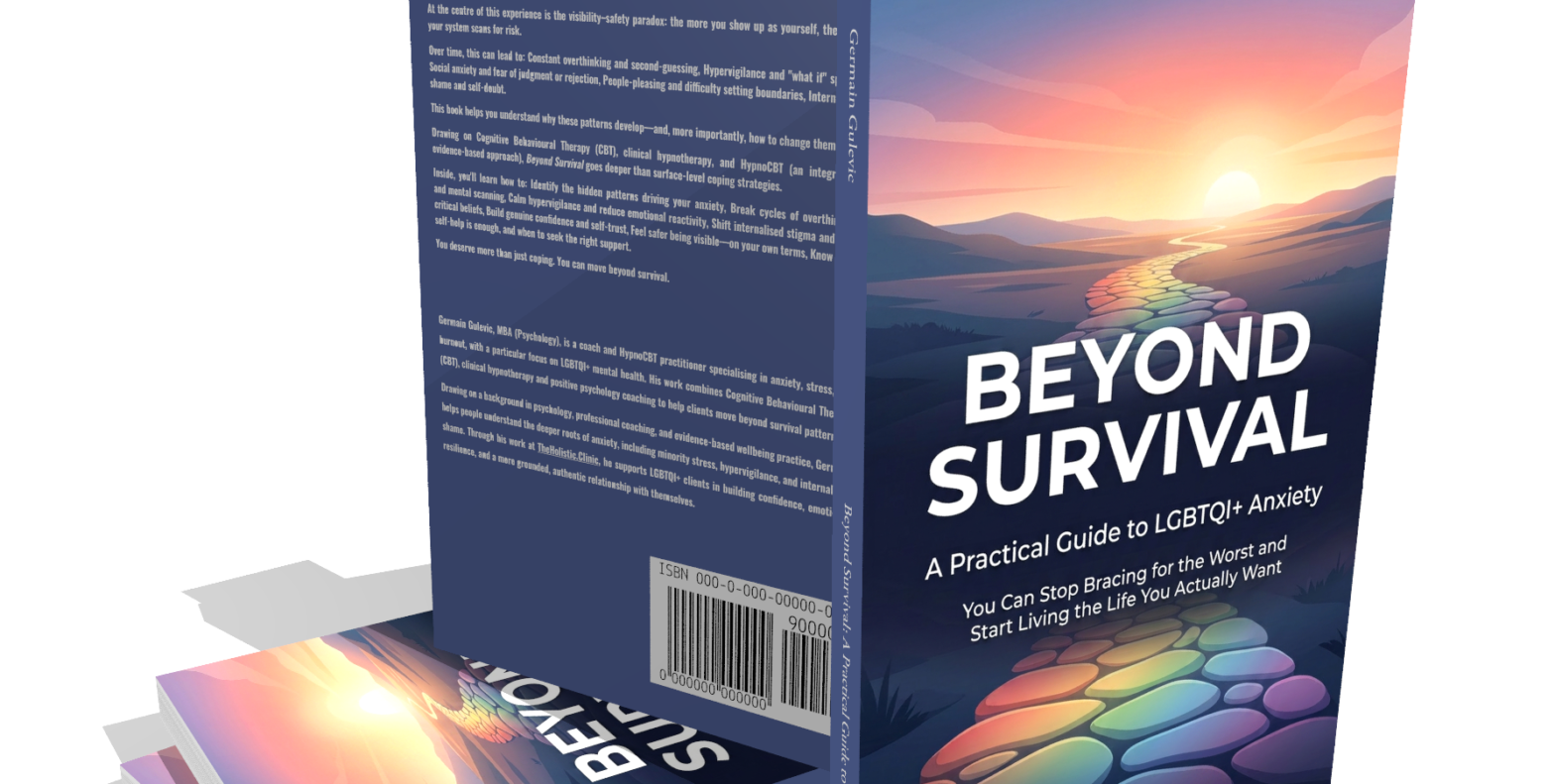
In brief: For many LGBTQI+ people, anxiety isn’t a random flaw — it’s an intelligent adaptation to years of navigating visibility, stigma and conditional belonging, a pattern documented as minority stress (Meyer, 2003). Beyond Survival by Germain Gulevic combines minority stress theory, affirmative CBT and clinical hypnotherapy (HypnoCBT) into a practical framework for updating those survival patterns — not just managing them forever.
If you’re LGBTQI+ and live with anxiety, there’s a good chance you’ve been told some version of the same story: that you overthink, react too strongly, or need to “just relax.” But what if your anxiety is not irrational at all? What if it makes sense?
For many LGBTQI+ people, anxiety is not a personal weakness. It is often a deeply intelligent response to years of navigating visibility, uncertainty, judgment, and the pressure to stay safe in environments that did not always feel safe. That’s exactly the starting point of Beyond Survival: A Practical Guide to LGBTQI+ Anxiety by Germain Gulevic, MBA (Psychology) — a practical, evidence-based guide created specifically for LGBTQI+ people who are tired of bracing for the worst and ready to build a life that feels more grounded, authentic and genuinely their own.
Why does LGBTQI+ anxiety often feel different?
A lot of anxiety advice treats symptoms in isolation — racing thoughts, avoidance, panic or overthinking, as if they appear out of nowhere. But for many queer and trans people, anxiety develops in context. It grows in environments where belonging feels conditional, where being visible can come with social costs, and where safety is never fully assumed. That context matters.
Research on minority stress has shown that LGBTQ+ people often carry an additional layer of chronic stress linked to stigma, discrimination, concealment, rejection, and the expectation of being judged or misunderstood (Meyer, 2003). Over time, that affects not only thoughts but the nervous system itself. This can look like scanning rooms before fully relaxing; editing yourself mid-sentence; overthinking how much to reveal; bracing for awkwardness or rejection; feeling exhausted by constant self-monitoring; and second-guessing whether it is safe to be fully visible.
These are not signs that something is wrong with you. They are signs that your system adapted. You can read more about the mechanism in Minority Stress and LGBTQ+ Mental Health.
What is the hidden cost of constant self-monitoring?
One of the most painful parts of LGBTQI+ anxiety is that it often becomes normal. You may function well on the outside — work, socialise, date, keep moving — while underneath, a constant background process runs all the time: How much of myself is safe here? Should I correct that? Do I explain or let it go? Am I being too much? What will this cost me?
That mental calculation is exhausting. It creates a kind of tension many people struggle to explain: wanting to be seen, while also feeling that being seen could trigger discomfort, scrutiny or danger. This is what Beyond Survival describes as the visibility–safety paradox — the tension between authenticity and protection that shapes so much LGBTQI+ anxiety. It’s explored in depth in The Visibility–Safety Paradox.
| On the outside | Running underneath |
|---|---|
| Working, socialising, dating, functioning | Constant calculations about what is safe to show |
| “Coping fine” | Chronic tension and exhaustion from self-monitoring |
| Appearing relaxed | Bracing for awkwardness, rejection or scrutiny |
| Managing | The quiet feeling: “I’m not fully here” |
If that sounds familiar, you are not alone. And more importantly, you are not broken.
Why does generic anxiety advice often fall short for LGBTQI+ people?
Many anxiety tools can be helpful — but for LGBTQI+ people, generic mental-health advice can feel incomplete, or even subtly invalidating. If someone tells you your fear is “just distorted thinking,” but your life experience has taught you that rejection, erasure or hostility can be real, that advice misses the point.
A more useful approach starts with honesty: some fears are grounded in real experience. The goal is not to pretend risk never exists — it is to understand when your nervous system is responding to present danger, and when it is responding to old survival patterns that now cost more than they protect. This is also why coping strategies alone often aren’t enough.
| Generic anxiety advice | Minority stress-informed approach | |
|---|---|---|
| Starting assumption | “Your fear is distorted thinking” | “Some fears are grounded in real experience” |
| The question it asks | “What’s wrong with me?” | “What has my system learned — and what is it costing me now?” |
| Treatment of risk | Tends to minimise or dismiss it | Distinguishes present danger from old survival patterns |
| The goal | Manage symptoms | Update the patterns that keep creating them |
What makes Beyond Survival different?
Beyond Survival combines three powerful elements in one practical framework:
| Framework element | What it contributes | The evidence |
|---|---|---|
| Minority stress theory | Explains why these patterns develop — stigma, discrimination, concealment and rejection as chronic stressors, not personal failings | Foundational framework linking stigma to LGBTQ+ mental health (Meyer, 2003); systematic review of associated mental-health outcomes (Mongelli et al., 2019) |
| Cognitive behavioural therapy (CBT) | Structured tools to work with thoughts, appraisals and behaviours — overthinking loops, avoidance, self-monitoring | LGBTQ-affirmative CBT significantly improves mental health in randomised controlled trials (Pachankis et al., 2015; Pachankis et al., 2022) and systematic review (Tudor-Sfetea & Topciu, 2024) |
| Clinical hypnotherapy / HypnoCBT | Reaches the automatic, subconscious layer — the bracing, scanning and shame responses that insight alone rarely shifts | Hypnosis is effective across mental and somatic health issues in a 20-year meta-analytic review (Rosendahl et al., 2024) and recognised by the Royal College of Psychiatrists |
Together, these approaches help readers understand not only what anxiety feels like, but why it developed and how to shift it. Instead of vague encouragement or empty affirmations, the book gives readers structured tools to help break the cycle of overthinking and mental scanning; reduce hypervigilance; work with internalised shame and self-criticism; feel safer being visible on their own terms; build grounded confidence; and develop discernment about when self-help is useful and when extra support is needed.
In other words, this is not about “managing anxiety forever.” It is about changing the patterns that keep creating it.
What practical tools does the book offer for real life?
One of the strengths of Beyond Survival is that it is deeply compassionate without becoming abstract. It speaks directly to the lived reality of LGBTQI+ anxiety — the fatigue, the self-editing, the internal negotiations, the emotional cost of staying legible, acceptable or safe in different spaces. But it also stays practical, introducing clear, usable tools for:
- understanding your personal anxiety patterns
- mapping triggers and responses
- calming the nervous system
- shifting the relationship between thoughts, body sensations and behaviour
- developing a more workable relationship with fear
It is especially relevant if your anxiety shows up as people-pleasing; avoidance; over-preparing; rumination; shame spirals; difficulty relaxing in social settings; fear of disclosure or visibility; or tension around dating, family, work or identity-based conversations. If you have ever thought, “I’m tired of surviving like this,” this book was written with that exact exhaustion in mind.
Who is this book for?
Beyond Survival is for LGBTQI+ readers who want something more specific, affirming and grounded than mainstream anxiety advice. It may especially resonate if you feel chronically on edge or hyper-aware in social situations; struggle with internalised shame or self-criticism; want to understand how minority stress affects mental health; are looking for an LGBTQI+-specific anxiety resource; want practical tools, not just theory; are interested in CBT, hypnotherapy or deeper emotional change; or want to feel more authentic without forcing yourself into unsafe situations.
Not sure where your own pattern sits? Use the free LGBTQI+ Anxiety Self-Assessment to see where you are now. This is not about becoming fearless — it is about becoming less governed by the alarm system that has been making too many decisions for too long.
Why does this conversation matter now?
There is increasing awareness that LGBTQ+ mental health cannot be understood properly without context. Affirmative CBT and minority stress-informed approaches are gaining more attention because they reflect something many people in the community have always known: anxiety is often shaped by what you have had to navigate, not just by what you think.
That shift matters. It moves the conversation away from “What’s wrong with me?” and toward “What has my system learned, and what is it costing me now?” That change alone can feel deeply relieving. And from there, real change becomes possible.
Where should you start?
If this article resonates with you, the best next step is to explore Beyond Survival. The book is available as an instant digital download in PDF and EPUB format, and there is a free introduction chapter on the book page, so you can get a feel for the approach before buying. You can explore it at book.theholistic.clinic.
Frequently asked questions about LGBTQI+ anxiety
Why is anxiety so common among LGBTQI+ people? Minority stress (Meyer, 2003) — the chronic stress of stigma, discrimination, concealment and anticipated rejection — adds a layer of load on top of everyday stressors. Over time it shapes not just thoughts but the nervous system itself, producing hypervigilance, self-monitoring and bracing that feel “normal” but are actually adaptations.
Is my anxiety irrational? Not necessarily. Many LGBTQI+ anxiety patterns were learned in environments where vigilance genuinely protected you. The useful question isn’t “what’s wrong with me?” but “what has my system learned to expect — and is that still true here?” Distinguishing present danger from old survival patterns is the starting point of real change.
What is the visibility–safety paradox? It’s the tension between wanting to be seen and authentic, and having learned that visibility can carry costs — discomfort, scrutiny or danger. Your system constantly calibrates between authenticity and protection, which is exhausting but entirely logical. Beyond Survival devotes a full framework to resolving it.
How is HypnoCBT different from standard CBT? Standard CBT works on conscious thoughts and behaviours. HypnoCBT adds clinical hypnotherapy to reach the automatic layer — the bracing, scanning and shame responses that insight alone rarely shifts. Both components have independent evidence: affirmative CBT in randomised trials (Pachankis et al., 2022) and hypnosis in meta-analytic review (Rosendahl et al., 2024).
Can a book really help with anxiety? A structured, evidence-based book can do a great deal — especially one that maps your patterns and gives you tools to practise, not just theory to read. Beyond Survival also builds in discernment about when self-help is enough and when extra support is needed. For community-specific guidance, the NHS offers dedicated mental-health support information for LGBTQ+ people.
What if I’m tired of just coping? That’s exactly the book’s premise. Coping strategies manage symptoms; the Beyond Survival framework targets the patterns that keep generating them — so you can live with less bracing, more clarity, and a stronger sense that your life belongs to you again.
Ready to move beyond survival?
Start with the LGBTQI+ Anxiety Self-Assessment to map your personal patterns, then get Beyond Survival: A Practical Guide to LGBTQI+ Anxiety — available as an instant digital download, with a free introduction chapter so you can try the approach first.
For personalised, affirming support — in London or online — book a free 15-minute consultation with The Holistic Clinic.
A final thought: LGBTQI+ anxiety is often discussed as if it exists in a vacuum. But many people are not anxious because they are weak or failing at life — they are anxious because they adapted, because they learned, because they had reasons to brace. Patterns can change: not overnight, not through denial, but through understanding, regulation, and the kind of structured support that respects lived experience instead of erasing it. Not perfection. Not forced positivity. Just a little less bracing, a little more clarity, and a stronger sense that your life can belong to you again.